
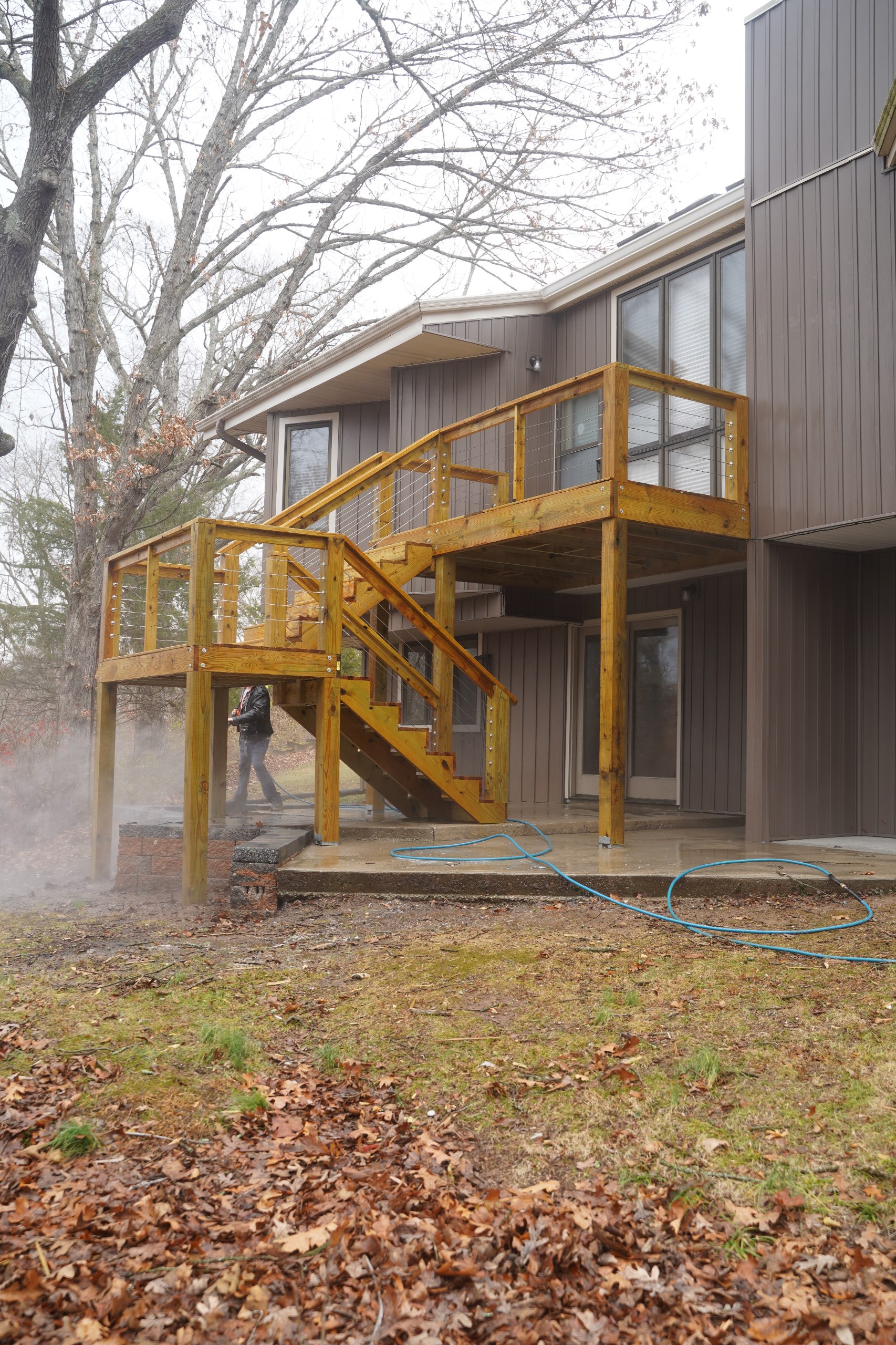
You built that deck 10 years ago. Maybe you inherited it when you bought the house. Either way, it's seen a decade of Springfield summers, Missouri winters, and everything in between. The boards are gray. Some are cracked. A few feel soft when you step on them. The railing wobbles a little more than it should.
So you're asking the question every homeowner eventually asks: do I restore this thing, or tear it out and start over?
We get this call at least once a week from homeowners in Springfield, Ozark, Nixa, and Republic. And our answer might surprise you — most 10-year-old decks are absolutely worth restoring. But there are exceptions, and the only way to know for sure is to get an expert out there to look at it.
Why 10 Years Isn't a Death Sentence
Here's what most people don't realize: a well-built deck with quality lumber can last 25-30 years with proper care. Even without great maintenance, the structural bones of most decks hold up far longer than the surface appearance suggests.
That gray, weathered look? That's just the top layer of wood fiber breaking down from UV exposure. It's cosmetic. Underneath, the wood is usually still solid. Those surface cracks? Most are shallow checks from expansion and contraction — they look bad but aren't structural.
The real question isn't "how does it look?" — it's "how's the structure?"
The 5-Point Deck Assessment
When we come out to inspect a deck in the Springfield area, here's exactly what we check:
- Posts and footings: Are the support posts solid? Is there rot at the base where they meet the ground or concrete? Are the footings stable?
- Ledger board: Where the deck connects to your house — this is the #1 failure point on aging decks. If the ledger is rotting or pulling away, that's a serious issue.
- Joists and beams: The horizontal framing under the deck boards. We check for rot, insect damage, and sagging. These are the backbone of your deck.
- Deck boards: How many are damaged beyond saving? If it's less than 30-40%, individual board replacement is almost always cheaper than rebuilding.
- Hardware and fasteners: Are the screws, bolts, and joist hangers corroded? Rusted hardware is easy to replace but needs to be caught.
"We've restored decks that homeowners were ready to demolish. Once we stripped the old finish, replaced a handful of boards, and applied fresh stain — they couldn't believe it was the same deck."
Restore vs. Rebuild: The Real Cost Difference
This is where the math gets real for homeowners in Springfield and the surrounding area:
Full Restoration
Power wash, strip old finish, repair damaged boards, sand, and apply professional-grade deck stain. A fraction of the cost of a rebuild — and often all you need.
Full Rebuild
Demo, disposal, new lumber, new hardware, labor, permits, and finishing. Significantly more expensive — the right call only when structure is compromised.
The cost difference is substantial. And in most cases, a restored deck will give you another 5-8 years of solid use before the next maintenance cycle. A restoration every 3-4 years is dramatically cheaper over a 20-year span than a single rebuild.
When You Actually Should Rebuild
We're not going to tell you to restore a deck that's genuinely past its prime. There are clear signs a rebuild is the right call:
- Structural rot in posts, beams, or the ledger board — if the foundation is compromised, surface work won't fix it
- More than 50% of deck boards need replacement — at that point, new lumber costs approach rebuild territory
- The deck wasn't built to code — older decks in Springfield sometimes have undersized joists, improper spacing, or missing hardware that makes them unsafe regardless of surface condition
- Major design change needed — if you want to change the size, shape, or height, rebuilding makes more sense than modifying
- Insect damage (termites, carpenter ants) — if the framing has been compromised by insects, repair costs can approach rebuild costs
What Springfield Weather Does to Decks
If you've lived in Springfield, Ozark, or Nixa for any length of time, you know our weather doesn't play nice with outdoor wood. A deck that might last 15 years in a mild, dry climate takes a beating here.
The main culprits:
- Freeze-thaw cycles: Springfield gets 100+ days per year where temps swing above and below freezing. Water gets into cracks, freezes, expands, and makes those cracks worse every single winter.
- Summer UV: Ozark summers are brutal on unprotected wood. A deck with no stain or sealer will turn gray within a year.
- Humidity and rain: 44+ inches of rain per year — more than Seattle. That moisture feeds mold, mildew, and rot on unprotected wood.
This is exactly why regular deck staining and sealing matters so much in our area. A deck that was stained every 3-4 years is going to be in dramatically better shape at the 10-year mark than one that was neglected.
The Bottom Line: Get an Expert Opinion First
Here's our honest advice to any homeowner in Springfield, Republic, Ozark, Nixa, or anywhere in the surrounding area with an aging deck:
Don't make the decision yourself.
It's nearly impossible for a homeowner to accurately assess structural integrity without getting under the deck and knowing what to look for. What looks terrible on the surface might be perfectly solid underneath. And what looks "fine" on top might be hiding rot in the joists that makes the deck unsafe.
We offer free on-site inspections. We'll come out, look at the structure, assess the surface, and give you a straight answer: restore or rebuild. If restoration makes sense, we'll quote it. If it doesn't, we'll tell you that too — we'd rather be honest than sell you a restoration that won't hold up.
Most of the time, the answer is restore. But you won't know for sure until someone who does this every day takes a close look.